Monthly Home Sales Information
.png)
Thinking About Downsizing in Ottawa? What September’s Housing Market Means for Your Plans
If you have been thinking about moving to a smaller home, buying a condo or exploring a retirement residence, you may be wondering what Ottawa’s latest housing numbers mean for you.
Does having more homes available make finding your next place easier? Will it make selling your current home more difficult? Should you move ahead or take more time?
Those are reasonable questions. September’s results give us some useful background, but the decision still begins with your needs, comfort and plans.
Let’s talk about what changed.
Buyers Had More Choice in September
The biggest development was the increase in homes coming onto the market.
Ottawa recorded 2,927 new listings in September, an increase of 38.1% from August. By the end of the month, there were 4,813 active listings, up 7.1% from August and 7.9% from September last year.
Some increase is normal at the beginning of the fall market, but this year’s rise in new listings was considerably larger than usual.
If you are looking for a more manageable home, additional choice may be helpful. It could give you more opportunities to compare layouts, maintenance responsibilities, locations and costs before deciding.
That does not mean every suitable property will be readily available. A home with the particular features you need may still take time to find.
Start With What Would Make Everyday Life Easier
When downsizing, it is easy to focus on the size of the property. But a smaller home is only helpful if it works better for the person living there.
Before looking at listings, think about your ordinary week.
Would main-floor laundry make a difference? Would you prefer fewer outdoor responsibilities? Do you want to remain close to your doctor, friends, family or familiar shops?
For someone considering a condominium, the building deserves as much attention as the unit. The distance from parking to the elevator, the entrance doors, storage, pet rules and monthly fees can all affect daily life.
A larger selection of homes gives you more to compare. A clear list of priorities helps you decide which ones are worth considering.
Sales Stabilized, but the Market Did Not Suddenly Bounce Back
There were 1,010 home sales in Ottawa during September, slightly more than the 1,002 recorded in August.
That small increase was unusual for the time of year. Sales typically decline between August and September. However, September’s total was still 6.6% below the same month in 2025.
It also followed a sharp drop in August.
I would describe September as a month when sales steadied after the slowdown. It is too early to say that it marked a broader recovery.
For a homeowner preparing to sell, the practical point is that buyers remained active, but the number of available properties grew much faster than the number selling.
Selling a Longtime Home Requires a Thoughtful Plan
When buyers have more choice, they can be more selective.
That makes it helpful to understand which properties will compete with your home and how buyers are likely to compare them.
A longtime family home does not necessarily need a new kitchen, new bathrooms and an extensive renovation before it can be sold. Before spending money, let’s look at what would help and what may be unnecessary.
The preparation plan might involve addressing a few repairs, improving lighting, cleaning, reducing excess furniture and presenting the rooms clearly.
It should also account for your circumstances. If you are living in the home, we need a workable showing routine. If you have already moved, we need a plan for maintaining and checking the property while it is listed.
Good preparation should support the sale without creating avoidable work or pressure for you.
Prices Were Fairly Steady, With Some Signs of Softness
Ottawa’s average residential sale price was $685,640 in September, down 1.0% from a year earlier and nearly unchanged from August.
The median sale price was $625,000, slightly higher than in August but 0.8% below September 2025.
The MLS® Home Price Index declined more noticeably. Because it helps account for differences in the types of homes selling, it can reveal changes that are less apparent in the average price.
The overall picture was mixed: headline prices remained relatively stable, while the index pointed to underlying softness.
For your planning, these citywide figures are a starting point. They are not a valuation of your home or a reliable estimate of what your next property will cost.
Those questions require a closer look at the relevant neighbourhoods and properties.
If You Are Selling and Buying, Look at Both Sides
A move to a more manageable home often involves two connected decisions.
You want to understand what you may receive from selling your current property. You also need to know what suitable replacement homes cost and what expenses will continue after the move.
More choice may help with the purchase, while increased competition may affect the sale. Both need to be considered together.
Before committing to either transaction, we can discuss:
- Whether buying first or selling first is practical.
- How much flexibility you have with moving dates.
- Whether temporary accommodation might be needed.
- What happens if the two closing dates do not align.
- Which financial questions need to be reviewed with your lender or financial planner.
The best sequence depends on your situation. There is no single approach that works for everyone.
Apartment Sales Were Weaker, but That Does Not Tell the Whole Story
Apartment sales fell 24.8% compared with September 2025, a larger decline than the decreases recorded for single-family homes and townhouses.
If you are considering a condo, that is useful context. However, it does not mean every condominium is an equally good opportunity or that every seller will accept a lower offer.
The unit’s condition, the building’s finances, monthly fees, accessibility and location still matter.
A property that seems attractively priced may come with responsibilities or limitations that do not suit your plans. The goal is to find a home that makes sense for your life and budget.
Moving to a Retirement Residence Involves a Different Timeline
If your next step is a retirement residence, the housing-market numbers are only one part of the planning.
You also need clarity about the residence’s availability, services, costs and admission arrangements. Those details help determine how the home sale should fit into the move.
Some people prefer to move before listing so they can settle in without managing showings. Others remain at home until it sells. Each approach has practical and financial considerations.
An early conversation can help identify what needs to happen, who will be involved and which dates are confirmed.
You Do Not Need to Make a Decision Based on One Month
September brought more listings, relatively steady sales and a greater selection for buyers.
The next few months will show whether that additional supply eases with the usual seasonal pattern. New listings declined in both October and November in each of the previous ten years, but we cannot assume this year will follow exactly the same path.
Your housing decision should reflect what is working in your current home, what has become more difficult and what you want for the years ahead.
You may be ready to move. You may be gathering information. You may decide that remaining where you are still makes the most sense.
If you are considering downsizing, exploring a retirement residence or helping an aging parent plan a move in Ottawa, I would be happy to help you understand the real estate options and organize the next steps.
Book your no-obligation consultation. Call 613-853-5807, email steve@stevesicard.ca
Market information based on the September 2026 Ottawa Real Estate Board figures supplied for this article.
.png)
Ottawa’s August Housing Market Slowed—What Does That Mean for Seniors and Downsizers?
If you have been thinking about selling a longtime home, downsizing, or helping an aging parent plan a move, you may be wondering what is happening in Ottawa’s real estate market.
The short answer is that the market slowed noticeably in August.
That does not mean home prices suddenly dropped or that nobody is buying. It does mean that homes generally faced less buyer activity, properties took longer to find the right buyer, and sellers had to compete more carefully for attention.
Let’s take a closer look at what happened—and what it may mean for your plans.
Home Sales Fell More Than Expected
A total of 1,002 homes were sold through the MLS® System in Ottawa during August. That was:
- 18.6% fewer sales than in August 2025
- 24.4% fewer sales than in July
- One of the lowest August sales totals recorded since 2016
It is normal for sales to decline between July and August, when vacations and summer plans often interrupt the market. However, the average July-to-August decline over the previous ten years was only 5.8%.
This year’s 24.4% drop was therefore considerably larger than a typical seasonal slowdown.
The decline was also seen across all three major property types:
- Single-family home sales declined 16.3%
- Townhouse sales declined 19.9%
- Apartment sales declined 22.3%
Earlier in the year, much of the weakness had been concentrated in townhouses and apartments. In August, the slowdown was more widespread.
Prices Were Much More Stable Than Sales
Despite the sharp decline in the number of homes sold, Ottawa home prices remained relatively steady.
The average residential sale price was $688,253, up 0.3% from August 2025. The median price was $622,357, down 1.2% from a year earlier.
The MLS® Home Price Index recorded a composite benchmark price of $637,700. That was 1% higher than in August 2025.
These different price measures tell us that Ottawa’s market is not moving uniformly in one direction. Sales activity weakened considerably, but overall property values did not experience the same degree of change.
As OREB President Tami Eades explained, steady prices alongside declining sales show that the market is more complicated than simply being “up” or “down.”
Buyers Have More Time and More Choice
There were 4,496 active listings available at the end of August. Although that was 3.9% lower than in July, it was still 11.3% higher than a year earlier and represented the largest August inventory since 2016.
Months of inventory also reached its highest August level since 2016.
For buyers—including seniors looking for a bungalow, condominium, smaller home or more manageable property—this may provide more breathing room.
There may be more time to:
- Compare different properties
- Consider whether a home will support future needs
- Review condominium documents and fees
- Arrange an inspection
- Discuss the decision with family
- Evaluate accessibility and maintenance requirements
- Make an informed offer without feeling as rushed
More choice can be helpful, but it can also make the search feel overwhelming. Before beginning, it is worth identifying the features that genuinely matter to your comfort, lifestyle and future plans.
Some Sellers Are Stepping Back
The slowdown was not caused by a sudden flood of new properties entering the market.
Ottawa recorded 2,119 new listings in August, unchanged from a year earlier but down 16.2% from July. Active listings also declined from the previous month.
However, sales fell much faster than inventory.
An Ottawa Real Estate Board review found that listing terminations, cancellations and expirations became more prominent compared with completed sales during the summer. In other words, a growing proportion of properties left the market without selling.
Some homeowners may be deciding to pause, adjust their expectations or reconsider whether this is the right time for them to sell.
For seniors and families, this is an important reminder that putting a home on the market should be part of a well-considered plan—not a decision made simply because someone says it is a “good” or “bad” market.
What Does This Mean If You Are Thinking About Downsizing?
A softer market does not automatically mean that you should delay your plans. It also does not mean you need to move ahead immediately.
The right decision depends on your circumstances.
If you are selling and purchasing in the same market, you may face more competition when selling your current home, but you may also encounter better selection and less pressure when buying your next one.
Your plan should take into account:
- The condition and location of your current home
- The type of property you hope to purchase
- How much preparation your home may require
- Your financial priorities
- Whether you need to sell before buying
- Your desired moving timeline
- Family, healthcare and lifestyle considerations
- Whether remaining in your current home is still practical
You do not need to have all the answers before starting the conversation.
Preparation Matters even more in a Slower Market
When buyers have more homes to choose from, they can be more selective. Proper preparation, realistic pricing and strong marketing become especially important.
Before listing, it may be helpful to review:
- Repairs or maintenance that should be addressed
- Decluttering and organizing
- Professional staging recommendations
- Photography and presentation
- Pricing based on recent comparable sales
- How showings will be managed
- What will happen if the home takes longer to sell
- How the sale will be coordinated with your next move
This does not mean spending heavily on renovations. The goal is to determine which improvements are worthwhile and which ones may not provide a meaningful return.
Planning Early Can Reduce Pressure
One month does not establish a long-term trend. August gave us a softer picture heading into the fall, but market conditions will continue to change.
If you are considering a move within the next few months—or even the next few years—an early conversation can help you understand your options without creating an obligation to sell.
We can talk about your current home, the type of property that might better support your lifestyle, the likely costs involved and the steps that may eventually be required.
Good planning gives you time, choices and greater control over the process.
I’m Steve Sicard, an Ottawa REALTOR® and Seniors Real Estate Specialist® who has been helping homeowners and families since 2007. If you are considering downsizing, moving to a more manageable home or helping an aging parent make housing decisions, I would be pleased to have a no-obligation conversation with you.
Book your no obligation consultation here.
png.png)
Ottawa July Real Estate Market Update: The Numbers Say Steady, But Does It Feel That Way?
Ottawa Home Sales, Prices and Inventory Remain Stable, but Buyers Have More Choice and Sellers Are Facing a More Selective Market
If you only looked at the July Ottawa real estate statistics, you might think the market had a pretty good month.
Ottawa home sales were virtually unchanged from last July, new listings declined slightly, inventory fell from June, and overall home prices remained relatively stable.
But there's another side to the story.
From what I'm seeing and hearing on the ground, the Ottawa housing market can still feel surprisingly slow—especially for some sellers.
And that's why I think we need to look beyond the headlines.
Ottawa Home Sales Held Steady in July
A total of 1,325 homes sold through the MLS® System in July, up just 0.2% from July 2025.
Sales declined 12.7% from June, but that's actually better than Ottawa's typical seasonal slowdown. Over the previous decade, the median June-to-July decline was approximately 20.7%.
There were 2,530 new listings, down 0.8% year-over-year, while active listings finished July at 4,678—9.3% higher than last year but 6.1% lower than June.
On paper, that points to an Ottawa real estate market moving toward better balance.
But statistics don't always tell us what it feels like to actually have a home on the market.
Some Orléans Sellers Are Experiencing a Very Different Market
I know of homes in Orléans that are listed in price ranges where we're seeing a relatively healthy number of sales, yet buyer activity has been surprisingly slow.
And it illustrates something important:
Homes can be selling in a neighbourhood while other well-positioned properties receive very little buyer traffic.
The two aren't contradictory.
Buyers Have More Choices
One reason may be inventory.
Although the number of homes available declined from June, Ottawa active listings remained 9.3% higher than a year ago.
More inventory means buyers can be selective.
Before booking a showing, they can compare price, location, condition, renovations, lot size, layout, days on market and competing properties.
Today's buyers can also learn an incredible amount about a property online.
Professional photography, video, floor plans and virtual tours can help buyers decide whether a home interests them before they ever walk through the door.
That can mean plenty of online views without necessarily producing plenty of showings.
Not Every Part of Ottawa Is Experiencing the Same Market
This is probably the most important thing to understand about the Ottawa housing market in 2026.
There really isn't one Ottawa market.
In July:
Single-family homes: 714 sales, up 5.0% year-over-year, with approximately 3.2 months of inventory.
Townhomes: 417 sales, down 4.1%, with approximately 3.0 months of inventory. The townhouse benchmark price remained 5.1% below last year.
Condo apartments: 169 sales, down 6.6%, with approximately 5.4 months of inventory. The apartment benchmark price was 5.2% lower than last year.
The condominium apartment market, particularly downtown, continues to be noticeably softer than many suburban markets.
That's why an Ottawa-wide statistic may have very little to do with what's happening to a particular home in Orléans, Barrhaven, Kanata, downtown Ottawa or another neighbourhood.
What Are Ottawa Home Prices Doing?
The average Ottawa residential sale price in July was $683,308, down 1.6% from July 2025.
But here's why I wouldn't focus on that number alone.
The median price was $635,000—unchanged from last year.
The MLS® Home Price Index composite benchmark was $634,000, down only 0.5% year-over-year and actually up 0.3% from June.
Taken together, those numbers point more toward price stability than a significant market-wide decline.
What Does This Mean If You're Selling a Home in Ottawa?
This isn't a market where homes aren't selling.
They are.
But buyers have choices, and getting their attention may require more patience than the headline sales numbers suggest.
Preparation, presentation, marketing and especially pricing relative to your current competition matter.
And when I'm looking at the value of a home, I don't just want to know what's sold.
I also want to know:
What's currently competing with it?
What's sitting on the market?
Which homes have reduced their prices?
How long are comparable homes taking to sell?
And what are buyers actually choosing?
Because your competition isn't the Ottawa average.
Your competition is what buyers see beside your home when they're deciding which properties are worth seeing.
So, Was the Ottawa Real Estate Market Strong or Slow in July?
I think the answer is:
Both.
Citywide, July held up reasonably well. Sales were essentially unchanged from last year, new listings eased, inventory declined from June and prices were relatively stable.
But that doesn't mean every seller experienced a busy market.
Some homes are selling while others—even in active price ranges—are seeing surprisingly few showings.
That's why I wouldn't make a buying or selling decision based on a headline saying the Ottawa real estate market is “up,” “down,” “strong” or “slow.”
If you're thinking about selling, buying, downsizing or rightsizing, let's look at your neighbourhood, your type of home, your price range and your competition.
That's where the real story of today's Ottawa real estate market begins.
Are you buying or thinking of selling? Book your no obligation consultation HERE
.png)
Ottawa Real Estate Market Update – June 2026: Is It a Good Time to Buy or Sell?
If you've been wondering what's happening in the Ottawa real estate market, you're definitely not alone.
Over the past few weeks, I've been getting questions like:
"Steve, are homes still selling?"" Have prices dropped?"" Is it a buyer's market now?"" Should I wait until the fall?"
Let's sit down over a coffee and talk about what the numbers are really telling us, without all the confusing headlines.
So... What's Happening in the Ottawa Housing Market?
The good news is that Ottawa's housing market remains balanced.
Think of it this way...
Buyers have more homes to choose from than they've had over the past few years, but well-priced homes are still attracting serious interest. We're no longer seeing the frantic bidding wars that became common a few years ago, but we're also not seeing prices collapse.
Instead, we're seeing a healthier market where buyers can take a little more time to make informed decisions, while sellers who price their homes correctly are still achieving excellent results.
That's good news for everyone.
Home Sales Slowed Slightly... But That's Normal
In June 2026, 1,518 homes sold through Ottawa's MLS® System.
That's about 5% fewer sales than June of last year, and slightly below May's total.
Before anyone panics...
This is actually quite typical.
Every year, once school begins to wrap up, vacations start, and families focus on summer activities, the real estate market naturally eases off from the busy spring pace.
So while sales were a little lower, the seasonal pattern isn't surprising.
More Homes on the Market Means More Choices
One of the biggest changes this year is inventory.
There are simply more homes available than buyers have seen over the past several years.
If you're buying, that's welcome news.
Instead of feeling rushed into making an offer on the first property you like, you can compare neighbourhoods, layouts, prices and features before making one of the biggest financial decisions of your life.
That doesn't mean sellers can't be successful.
It simply means pricing, presentation and marketing have become much more important than they were during the pandemic frenzy.
Not Every Type of Home Is Performing the Same
Here's where the market gets interesting.
When people hear "Ottawa housing market," they often assume every property is behaving the same way.
That's simply not true.
Single-Family Homes Continue to Lead
Detached homes remain the strongest segment of the market.
Demand has stayed relatively steady, inventory remains manageable, and these homes continue attracting the greatest number of buyers.
If you're selling a detached home that's priced appropriately and shows well, you're still in a very good position.
Townhomes Are a Little More Competitive
Townhomes remain popular, but they're seeing a bit more competition as inventory grows.
That means buyers have more options, making pricing even more important for sellers.
Condominiums Continue to Face the Biggest Challenges
Apartment-style condominiums remain the softest part of Ottawa's real estate market.
With more inventory available, buyers have greater negotiating power, meaning condo sellers need to be especially strategic when preparing and pricing their homes.
What About Home Prices?
This is where headlines can become confusing.
The average residential sale price in Ottawa during June was $733,648, which is 1.3% higher than one year ago.
However...
The median sale price was $655,000, which is 1.3% lower than last June.
How can both be true?
Because average prices can be influenced by more expensive homes selling during the month.
Median prices often provide a clearer picture of where the "middle" of the market sits.
The takeaway?
Prices remain relatively stable.
We're not seeing dramatic increases, but we're also not seeing widespread price declines.
Homes Are Still Selling Close to Asking Price
One statistic that often gets overlooked tells us a lot about today's market.
Homes sold for an average of 98.5% of their asking price, virtually unchanged from last year.
That tells us buyers are negotiating—but not dramatically.
Sellers who price realistically are still receiving very strong offers.
Homes Aren't Sitting on the Market Much Longer
Another encouraging sign?
The median days on market increased only slightly—from 19 days to 22 days.
That's hardly a major slowdown.
Instead, it suggests buyers are taking a little more time to make thoughtful decisions rather than rushing into offers.
For many people, that's actually a healthier market.
Why Local Neighbourhood Knowledge Matters More Than Ever
One of the biggest mistakes buyers and sellers make is relying solely on city-wide statistics.
Ottawa isn't one market.
It's dozens of neighbourhood markets.
What's happening in Orléans can be very different from Barrhaven.
Kanata may perform differently than Alta Vista.
Condominiums in downtown Ottawa can behave very differently from detached homes in Cumberland.
That's why local knowledge has become more valuable than ever.
Understanding your specific neighbourhood, property type, price range and current buyer demand often makes a much bigger difference than any city-wide headline.
So... Is Now a Good Time to Buy or Sell?
Honestly?
For many people...
Yes.
If you're buying, you'll likely appreciate having more selection and fewer bidding wars.
If you're selling, properly priced homes continue to attract serious buyers and sell close to asking price.
The key isn't trying to "time the market."
The key is making sure your decision fits your life, your finances and your future plans.
Final Thoughts
The Ottawa real estate market in June 2026 continues to demonstrate stability.
Inventory is higher than we've seen in recent years, giving buyers more choice while encouraging sellers to price strategically.
Detached homes remain the strongest market segment, townhomes continue to perform well with proper pricing, and condominiums are presenting the greatest opportunities for buyers.
If you're thinking about buying, selling, downsizing, rightsizing, or simply wondering what your own neighbourhood is doing, remember that every area of Ottawa tells a different story.
Having accurate, local information can make all the difference.
I'd be happy to sit down over a coffee for a no-obligation conversation about your goals, answer your questions, and help you understand exactly what's happening in your neighbourhood—so you can make confident decisions when the time is right.
Frequently Asked Questions About the Ottawa Housing Market
Is Ottawa currently a buyer's market? Ottawa remains a balanced real estate market. Buyers have more inventory and choice than in recent years, but well-priced homes continue to sell successfully.
Are Ottawa home prices falling? Overall prices have remained relatively stable. While the median price dipped slightly compared to last year, average sale prices increased modestly, reflecting differences in the types of homes being sold.
What type of home is selling best in Ottawa? Single-family detached homes continue to show the strongest demand, followed by townhomes. Apartment-style condominiums remain the softest market segment.
Should I wait to buy or sell? Every situation is different. Rather than trying to predict the market, it's usually better to make your decision based on your personal goals, finances and lifestyle, while understanding what's happening in your specific neighbourhood.
Ready to Talk About Your Situation?
Every homeowner's circumstances are unique. Whether you're thinking about buying, selling, downsizing, rightsizing, or simply wondering what your home might be worth in today's Ottawa real estate market, I'd be happy to help.
Let's have a relaxed, no-obligation conversation about your goals, answer your questions, and explore the options that make the most sense for you.
👉 Want to discuss your personal situation? Click here to book your complimentary consultation.
.png)
Ottawa Real Estate Market Update – May 2026: More Choices, More Competition, and a Balanced Market
If you've been wondering what's happening in the Ottawa real estate market, you're not alone. One of the most common questions I hear from buyers and sellers is:
"Is it a good time to buy or sell a home in Ottawa?"
The answer depends on your personal situation, but the latest Ottawa housing market statistics provide some valuable insight into what we're seeing across the city.
As we moved through the spring market, activity picked up as expected. However, the Ottawa real estate market continues to look very different from the fast-paced conditions we experienced a few years ago. Today's market is more balanced, giving buyers more options while requiring sellers to be strategic and realistic with pricing.
Let's take a closer look at what happened in May 2026 and what it could mean for homeowners, buyers, downsizers, and investors.
Ottawa Home Sales Increased in May
As expected, home sales increased from April to May as the spring market gained momentum.
A total of 1,616 homes sold in Ottawa during May 2026, compared to 1,336 sales in April.
While this month-over-month increase is encouraging, sales remained 10.6% lower than May 2025.
This has become one of the key themes of the Ottawa housing market in 2026. Homes are selling, buyers are active, and transactions are happening every day—but the pace remains slower than what we saw last year.
More Homes for Sale Means More Choice for Buyers
One of the biggest changes in today's Ottawa real estate market is inventory.
At the end of May, there were 4,917 active residential listings, providing buyers with significantly more choice than they had during the highly competitive markets of recent years.
From a buyer's perspective, that's good news.
More listings mean:
- More homes to choose from
- More time to make decisions
- Less pressure to compete in multiple-offer situations
- Greater ability to compare neighbourhoods and property types
For sellers, however, it means increased competition.
When buyers have more options available, pricing, presentation, and marketing become even more important.
Ottawa Home Prices Remain Stable
Despite slower sales and increased inventory, one thing has remained remarkably consistent: home prices.
The Ottawa real estate market continues to demonstrate stability.
The average residential sale price in May was $721,270, up from $712,184 in April and only 0.9% lower than May 2025.
The median sale price reached $660,000, compared to $650,000 in April, while sitting just 1.6% below last year's level.
For homeowners wondering whether values are holding, the answer is generally yes.
While we aren't seeing dramatic price growth, we're also not seeing significant price declines across the broader market.
Single-Family Homes Continue to Lead the Market
When we break the numbers down by property type, the picture becomes even more interesting.
Single-Family Homes
Single-family homes continue to be the strongest segment of the Ottawa housing market.
Average prices remained essentially unchanged from last year, while median prices increased by approximately 1.3%.
This suggests continued demand for detached homes, particularly in established suburban neighbourhoods.
Townhomes
Townhomes remain popular due to affordability, but pricing softened modestly compared to last year.
For buyers, this may create opportunities to enter the market at a more favourable price point.
Condos and Apartment-Style Properties
Condominiums and apartment-style properties continue to experience softer market conditions.
Both average and median prices remain below 2025 levels, reflecting increased inventory and more cautious buyer activity in this segment.
For buyers considering condo ownership, today's market may offer more negotiating power and greater selection than we've seen in several years.
What Does a Balanced Market Mean?
One phrase you'll hear frequently when discussing Ottawa real estate is:
"Balanced market."
So what does that actually mean?
In simple terms, a balanced market is one where neither buyers nor sellers have a significant advantage.
The sales-to-new-listings ratio reached 48.2% in May, while inventory levels sat at approximately 3 months of supply.
These figures indicate a market where:
✔ Homes are selling
✔ Buyers have choices
✔ Sellers can still achieve strong results with proper pricing
✔ Neither side has complete control of negotiations
For most people, balanced markets are healthy markets because they create more predictable conditions.
Ottawa Market Trends for 2026
Looking at the year-to-date numbers provides additional perspective.
So far in 2026:
- 5,453 homes have sold
- Sales are down 6.3% compared to the same period in 2025
- 12,284 new listings have come onto the market
- New listings are up 5.4%
- Active listings are up 14.8%
The year-to-date sales-to-new-listings ratio of 44.4% and 3.5 months of inventory continue to support the view that Ottawa remains a balanced real estate market.
However, sellers are facing more competition than they did last spring.
What Could Influence the Ottawa Housing Market This Summer?
One of the biggest questions heading into summer is whether buyer demand will continue keeping pace with the growing supply of homes.
Several factors could influence market activity, including:
- Consumer confidence
- Employment trends
- Interest rates
- Economic uncertainty
- Inventory levels
- Affordability concerns
While these factors continue to evolve, Ottawa remains one of Canada's most stable housing markets thanks to its diversified economy, strong public sector presence, and steady population growth.
What This Means for Buyers
If you're considering buying a home in Ottawa, today's market offers opportunities that weren't available a few years ago.
You may benefit from:
- More available listings
- Greater selection
- More time to evaluate properties
- Increased negotiating opportunities
- Less competition in some market segments
Preparation remains important, but buyers generally have more flexibility than they did during the peak seller's markets.
What This Means for Sellers
If you're thinking about selling your Ottawa home, success is still very achievable.
However, today's market rewards preparation.
The homes that tend to perform best are:
- Properly priced
- Professionally presented
- Well marketed
- Move-in ready whenever possible
Buyers have options, and they are taking more time to compare properties before making decisions.
Strategic pricing and strong presentation are more important than ever.
Final Thoughts on the Ottawa Real Estate Market
The Ottawa housing market in May 2026 continued to show stability despite slower sales compared to last year.
Inventory levels remain elevated, giving buyers more choice and creating greater competition among sellers. At the same time, home prices have remained relatively stable, particularly in the single-family home segment.
Whether you're buying your first home, selling a family property, rightsizing for retirement, downsizing, or simply curious about your home's value, understanding local market conditions is essential.
Real estate is local, and conditions can vary significantly between neighbourhoods, property types, and price ranges.
If you're thinking about making a move in Ottawa and would like a personalized assessment of your situation, I'd be happy to help. Let's have a no-obligation conversation about your goals and explore the opportunities available in today's market. Click HERE to book your consultation.
.png)
Ottawa Real Estate Market Update – Spring 2026 Market Continues to Stabilize
The Ottawa housing market is continuing to gain momentum this spring after a quieter winter season. As we move deeper into 2026, market conditions across Ottawa are becoming more balanced, creating opportunities for both buyers and sellers.
Inventory levels remain higher than what we experienced during the intense seller’s market of previous years, but supply has started to stabilize. Combined with an increase in spring listings, buyers are benefiting from greater choice and more flexibility throughout the home-buying process.
If you’ve been asking yourself whether now is the right time to buy or sell a home in Ottawa, current market trends suggest conditions are improving steadily while remaining relatively balanced.
Ottawa Spring Housing Market Showing Signs of Recovery
April brought stronger activity levels across Ottawa’s real estate market, continuing the seasonal pickup that often happens during the spring months.
More homeowners are listing their properties, giving buyers additional options in many neighbourhoods throughout the city. Inventory has been trending upward since late summer 2025, and the typical spring increase in new listings has further expanded available housing supply.
While increased inventory creates more competition among sellers, it also helps maintain healthier and more balanced market conditions overall.
Recent market activity indicates that many buyers who were hesitant earlier in the year are beginning to return to the market as confidence gradually improves.
Ottawa Condo Market Still Facing Challenges
Different areas of Ottawa continue to perform differently depending on property type and location.
Central Ottawa, particularly areas with a larger concentration of condominium apartments, continues to experience softer market conditions compared to many suburban communities.
Condo inventory remains elevated, and units are generally taking longer to sell. Buyers currently have more negotiating power in the condo segment, along with a wider selection of available properties.
For condo owners thinking about selling, strategic pricing, strong presentation, and professional marketing remain extremely important in today’s environment.
Ottawa Suburban Neighbourhoods Remain Strong
Suburban areas across Ottawa’s east, west, and south ends continue to show the most stable market conditions.
Neighbourhoods such as Orléans, Kanata, Barrhaven, and Stittsville are still seeing healthy buyer activity, although sales volumes have moderated slightly compared to previous peak years.
Among Ottawa’s suburban markets, the west end continues to perform particularly well due to:
- Consistent buyer demand
- Lower inventory pressure
- Stable pricing conditions
- Stronger absorption rates
Many families continue to prioritize suburban living for larger homes, quieter communities, outdoor space, and lifestyle benefits.
Rural Ottawa Real Estate Market Moving at a Slower Pace
Rural communities surrounding Ottawa continue to operate under more buyer-friendly conditions.
Higher inventory levels and longer selling timelines are common in rural markets, creating additional opportunities for buyers searching for acreage, country homes, or more space outside the city.
Because rural markets typically have fewer transactions overall, pricing trends can fluctuate more noticeably from month to month.
Is Ottawa a Buyer’s Market or Seller’s Market?
Currently, Ottawa’s housing market is best described as balanced.
This means:
- Buyers have more options and negotiating flexibility
- Sellers can still achieve strong sale prices with proper preparation
- Well-priced homes continue to attract serious interest
- Market conditions are becoming more normalized compared to previous years
Rather than heavily favouring buyers or sellers, Ottawa’s market is continuing to move toward a more stable and sustainable environment.
What Ottawa Buyers Should Know Right Now
For home buyers, today’s market conditions offer several advantages:
- Increased inventory and property selection
- Reduced competition in some market segments
- More time to evaluate homes carefully
- Greater ability to include conditions in offers
- Better opportunities in condo and rural markets
That said, desirable homes in popular suburban neighbourhoods can still sell quickly when priced appropriately.
What Ottawa Sellers Need to Focus On
For sellers, preparation remains one of the most important factors for success.
Homes that tend to perform best in today’s market are:
- Properly priced for current conditions
- Professionally photographed and marketed
- Clean, updated, and well presented
- Move-in ready whenever possible
Because buyers now have more options, presentation and pricing strategy are becoming increasingly important.
Ottawa Real Estate Forecast for Spring and Summer 2026
Looking ahead, Ottawa’s real estate market appears to be steadily improving as the spring season progresses.
Although activity levels have not fully recovered from the slower winter months, recent increases in buyer activity suggest momentum may continue building into the summer market.
Despite broader economic uncertainty, Ottawa’s housing market continues to demonstrate greater stability than many larger Canadian cities.
Home prices have remained relatively steady, and overall demand continues to support balanced market conditions without dramatic swings in either direction.
Final Thoughts on Ottawa’s Housing Market
Ottawa’s real estate market continues to transition toward a more balanced and stable environment in 2026.
Suburban neighbourhoods remain some of the strongest and most active areas of the market, while central condo-heavy communities and rural areas are experiencing slower sales activity and higher inventory levels.
Whether you are planning to buy, sell, downsize, or simply explore your options, understanding current Ottawa real estate trends and neighbourhood-specific conditions can help you make more informed decisions.
Every move is unique, and having a customized plan that fits your goals and timeline can make a significant difference in today’s market.
If you’re thinking about making a move in Ottawa, I’d be happy to help with a no-obligation, hassle-free consultation tailored to your needs and goals.
👉 Click here to schedule your consultation today.
.png)
.png)
🏡 Ottawa Real Estate Market Update (Q1 2026): What Buyers & Sellers Need to Know
Typically, I show the numbers for the month and how they compare to the same month last year.
But now that the first quarter of 2026 is complete, I wanted to take it a step further.
👉 I’ve added monthly sales data by property type to give you a clearer picture of how prices are actually moving right now.
Because here’s the truth: 📊 Year-over-year stats are helpful if you’re just curious about your home’s value… 💡 But month-to-month trends are far more useful if you’re thinking about buying or selling.
Let’s break it down 👇
📈 The Ottawa Market Is Gaining Momentum
After a slower winter, March showed clear signs of early spring activity.
👉 More buyers are stepping back into the market 👉 Sales activity is picking up 👉 Especially in the single-family home segment
While sales are still slightly below a “typical” March, the pace of improvement is accelerating.
💡 In simple terms: The market is waking up—and gaining traction.
🏘️ Inventory Is Rising… But So Are Sales
One of the biggest stories right now:
📦 More homes are hitting the market 📈 But buyers are keeping up
This balance is important.
👉 It’s leading to a gradual tightening of the market 👉 Months of inventory are declining 👉 Homes are being absorbed more consistently across all property types
💡 This is what we call a healthy, balanced market
💰 Prices Are Starting to Firm Up
Here’s where it gets interesting for both buyers and sellers 👇
The MLS® Home Price Index has now recorded: 📈 Two consecutive months of price increases across most property types
That tells us: 👉 Home values are strengthening 👉 Buyer confidence is returning 👉 The spring market is taking shape
💡 We’re not seeing wild spikes—just steady, sustainable growth.
⚖️ A Balanced Market (With Momentum Building)
According to Ottawa Real Estate Board, Ottawa remains in balanced territory.
And that’s actually a good thing.
As Tami Eades President of the Ottawa Real Estate Board (OREB) explains:
“What we’re seeing is a measured, steady return to activity. Inventory is up, sales are improving, and pricing is firming without overheating.”
👉 Translation: No chaos. No crash. No frenzy. Just a stable market with growing momentum.
🔮 What’s Coming Next?
Looking ahead, the outlook from Canadian Real Estate Association suggests:
📈 Demand is expected to strengthen 📉 Borrowing conditions may ease 🏡 Ottawa is already starting to align with this trend
On top of that, recent federal and provincial housing policies could:
👉 Increase activity 👉 Improve supply 👉 Support long-term stability
💡 What This Means for You
🏠 If You’re Buying:
- More inventory = more choice
- Prices are stabilizing (but starting to rise)
- Acting sooner could give you an advantage
🏡 If You’re Selling:
- Buyer demand is returning
- Pricing is strengthening
- Proper strategy is more important than ever
🤔 If You’re Just Watching:
- Your home value is likely stabilizing or increasing
- The market is not declining—it’s resetting and rebuilding momentum
📊 Why This Data Matters
This is exactly why I like to look at monthly trends, not just yearly comparisons.
Because real estate decisions aren’t made based on last year… 👉 They’re made based on what’s happening right now
📲 Thinking About Making a Move?
Whether you’re buying, selling, or just exploring your options…
💬 Let’s have a conversation. No pressure. Just clear insights to help you make the right decision for your situation.
Contact me HERE

Ottawa Housing Market Update February 2026: Home Prices Stabilize as Inventory Rises
Ottawa’s real estate market continued its typical winter slowdown in February 2026, with overall home sales remaining below the historical average for this time of year. However, the latest statistics from the Ottawa Real Estate Board show that the market is more balanced than the headline numbers may suggest.
While fewer homes sold compared to previous years, home prices across several property types are stabilizing and even showing signs of improvement. This indicates that the Ottawa housing market may be gradually transitioning toward a more balanced environment as the spring real estate season approaches.
Ottawa Home Sales in February 2026
In February 2026, 780 residential properties were sold in Ottawa, representing a 6.8% decrease compared to February 2025. Sales activity did improve from January’s 610 transactions, but it still remained below the typical sales levels seen during February in previous years.
Despite the slower pace, buyer demand remains active, particularly in more affordable price ranges. Many buyers are still competing for well-priced homes, and in some cases, multiple offer situations are still occurring when properties are priced correctly.
At the same time, higher inventory levels and ongoing economic uncertainty are causing some buyers to take a more cautious approach before making purchasing decisions. Even so, the median days on market currently sits at 24 days, showing that desirable properties can still sell relatively quickly.
Ottawa Home Prices Show Stability Despite Lower Sales
Pricing trends in February reflect a market adjusting to higher inventory levels rather than experiencing widespread price declines.
Key price statistics for February include:
Average residential sale price: $662,773
Year-over-year change: Down 1.0%
Median sale price: $615,450
Year-over-year change: Down 3.1%
These relatively modest changes suggest that Ottawa home prices remain stable overall. Instead of a major downturn, the housing market appears to be recalibrating following several years of strong price growth.
Another key indicator is the MLS® Home Price Index (HPI) published by the Canadian Real Estate Association. The HPI tracks price trends while adjusting for seasonal fluctuations and differences in the types of homes sold.
In February, benchmark prices increased month-over-month across every major housing segment, including:
Single-family homes
Townhouses
Condo apartments
The overall composite benchmark price
These increases suggest that property values may be beginning to strengthen again, even though winter sales activity remains slower than usual.
Ottawa Condo Market Showing Early Signs of Recovery
The Ottawa condominium apartment market may be starting to recover after experiencing higher inventory levels since late 2025.
Average condo prices increased month-over-month, while available inventory began to ease slightly. This trend suggests that the market may slowly be absorbing the additional supply of condominium listings that built up over the past year.
If this pattern continues, the Ottawa condo market could become more balanced as we move into the spring market.
Townhomes Lead Sales Activity in Ottawa
Among all property types, townhomes experienced the strongest sales activity in February.
Sales in this segment were stronger than typical February levels, driven largely by buyers searching for more affordable alternatives to detached homes while still wanting additional living space compared to condo apartments.
However, the increase in townhome inventory has started to place some downward pressure on prices, giving buyers slightly more negotiating power in this segment.
Detached Homes in Ottawa Remain Relatively Stable
The single-family home market in Ottawa remained relatively stable during February.
Although total sales declined compared to the previous year, prices for detached homes held steady overall. Data also suggests that lower-priced detached homes are attracting significant buyer interest, highlighting the continued importance of affordability in today’s housing market.
Ottawa Housing Inventory Gives Buyers More Choice
One of the biggest shifts in the Ottawa real estate market is the increase in available housing inventory.
February market data shows:
New listings: 1,582 (down 7.8% year-over-year)
Active listings: 2,928 homes available at month-end
Year-over-year inventory increase: 11.1%
With more homes available for sale, buyers have more options and less urgency, allowing them to carefully evaluate properties before making offers.
However, improving sales activity and rising benchmark prices indicate that demand remains present and continues to absorb the available supply.
Months of Inventory by Property Type
Months of inventory is an important indicator used to determine whether a real estate market favors buyers or sellers.
February’s figures suggest that the Ottawa housing market is currently operating in balanced conditions:
Single-family homes: 3.8 months of inventory
Townhomes: 2.7 months of inventory
Condo apartments: 5.6 months of inventory
Typically, four to six months of inventory represents a balanced real estate market, where neither buyers nor sellers have a strong advantage.
Ottawa Real Estate Market Outlook for 2026
The February numbers reinforce a trend that first appeared earlier this year: Ottawa’s housing market is entering a transitional phase.
Although this winter has been slower than in recent years, several encouraging signs are emerging, including:
Rising month-over-month benchmark prices
Improving absorption in the condo market
Strong demand for townhomes
Stable pricing in the detached home market
According to forecasts from the Canadian Real Estate Association, housing demand across Canada is expected to gradually strengthen throughout 2026, particularly as borrowing costs begin to ease.
If this momentum continues into the spring market, the current level of inventory could support higher sales activity without the rapid price growth seen in previous real estate cycles.
What This Means for Ottawa Buyers and Sellers
For home buyers in Ottawa, the current market offers more choice and slightly more time to make thoughtful purchasing decisions compared to the competitive markets of recent years.
For home sellers, steady demand and gradually strengthening prices indicate that well-priced homes can still attract strong buyer interest, especially in affordable price ranges.
With the spring real estate market approaching, the next few months could represent an important opportunity for both buyers and sellers who are ready to make their move in the Ottawa housing market.
.png)
Ottawa Housing Market Update January 2026: Rising Inventory, Balanced Prices, and What It Means for Buyers and Sellers
Ottawa’s residential real estate market has stepped into 2026 with a noticeable shift toward balance, creating opportunities for both buyers and sellers. After several years of fast-paced and highly competitive conditions, the market is now showing signs of stability, increased housing choice, and more realistic pricing expectations.
Here’s a closer look at what’s happening in Ottawa’s housing market and what it means if you’re thinking about buying or selling this year.
A More Balanced Ottawa Real Estate Market in 2026
Ottawa’s housing market is currently operating on more stable footing compared to recent years. Inventory levels have increased, giving buyers more options and reducing the intense competition that previously defined the market. At the same time, sellers are adjusting their pricing strategies to reflect current market conditions, which now reward accuracy and patience.
Benchmark home prices have declined slightly year-over-year across most housing categories. The softening is most noticeable in townhomes and condominium apartments, while detached homes have maintained stronger price stability. Overall, the January market data suggests Ottawa is moving toward a healthier, more balanced real estate environment rather than experiencing widespread downward pressure.
Tami Eades, President of the Ottawa Real Estate Board, noted that the current market reflects a natural adjustment period. With increased selection for buyers and more realistic expectations from sellers, pricing is stabilizing without dramatic swings — a key indicator of long-term market strength.
Ottawa Housing Inventory Is Rising — But Not Oversupplied
One of the biggest factors influencing Ottawa’s real estate market is the increase in housing supply. In January 2026, new residential listings reached 1,522 properties, representing an 8.8% increase compared to the same time last year. Active listings rose to 2,673 homes, marking a significant 22.7% increase year-over-year.
While inventory remains higher than recent seasonal trends, the pace of growth has slowed. This moderation is helping prevent an oversupply of homes and is contributing to a more stable housing environment.
Ottawa currently sits at approximately 4.4 months of housing inventory, which is much closer to historical pre-pandemic averages. This level typically indicates a balanced market where neither buyers nor sellers hold a significant advantage.
What This Means for Ottawa Home Buyers
For buyers, the current Ottawa housing market offers increased flexibility and improved negotiating power. Higher inventory levels mean more property options, more time to make informed decisions, and greater opportunities to negotiate price, conditions, or closing timelines.
However, well-priced and desirable homes continue to attract strong interest. Buyers who are financially prepared and working with knowledgeable real estate professionals still have the best chance of securing the right property.
What This Means for Ottawa Home Sellers
Sellers can still achieve strong results in Ottawa’s current market, but pricing strategy has become more important than ever. Homes that are accurately priced for today’s conditions are continuing to generate steady buyer interest and successful sales.
Overpricing, on the other hand, can lead to longer days on market and reduced negotiating leverage. Sellers who focus on preparation, presentation, and competitive pricing are seeing the most success in 2026.
Detached Homes Showing Stronger Stability
While many housing types are experiencing moderate price adjustments, detached homes in Ottawa are demonstrating greater resilience. These properties continue to benefit from strong buyer demand, particularly among families seeking space, privacy, and long-term value.
Townhouses and condominiums remain attractive entry points for buyers, but these segments are experiencing slightly softer pricing as inventory options grow.
Ottawa’s Real Estate Outlook for 2026
The Ottawa housing market is not showing signs of distress — rather, it is transitioning into a more sustainable and predictable environment. Increased supply is improving accessibility for buyers while encouraging realistic expectations for sellers.
Balanced conditions like these typically support healthier long-term market growth, improved affordability, and reduced volatility. For both buyers and sellers, 2026 is shaping up to be a year that rewards preparation, professional guidance, and informed decision-making.
If you’re considering buying or selling a home in Ottawa and want to understand how these market trends affect your specific situation, connect with me — Click HERE to contact me.

Ottawa’s Housing Market — Balanced, but Starting to Soften
Ottawa’s real estate market took a gentle step into winter this November, and the numbers tell an interesting story. Between cooler weather and a cautious economy, home sales slowed down compared to both October and last November. While the market is still considered balanced, there are definite signs that supply is beginning to outpace demand.
A Shift Toward More Supply
Active listings dipped slightly month over month, but something important happened: months of inventory (MOI) increased again. This signals that, even with fewer new listings hitting the market, homes are taking longer to sell — giving buyers more options and time to make decisions.
This softening is more noticeable than what we usually see in November. Normally, inventory rises a bit heading into winter, but this year the increase is stronger, especially in townhomes and apartments. With more properties available in these segments, buyers have more leverage, and sellers need to pay close attention to pricing and presentation.
What’s Ahead?
There’s some good news: recent interest rate cuts along with the December 10th Bank of Canada announcement that they are holding the rate at 2.25%, may spark renewed buyer activity over the winter. Even though this time of year is traditionally quiet, lower borrowing costs could bring a boost of confidence back into the market.
Looking ahead, Ottawa appears to be setting up for:
A steadier start to the new year, and
A more active, energized spring market.
Whether you’re buying, selling, or just keeping an eye on the market, understanding these shifts helps you plan your next move with confidence.
Would you like more information or to review your home buying or selling plans, click HERE to book a conversation.
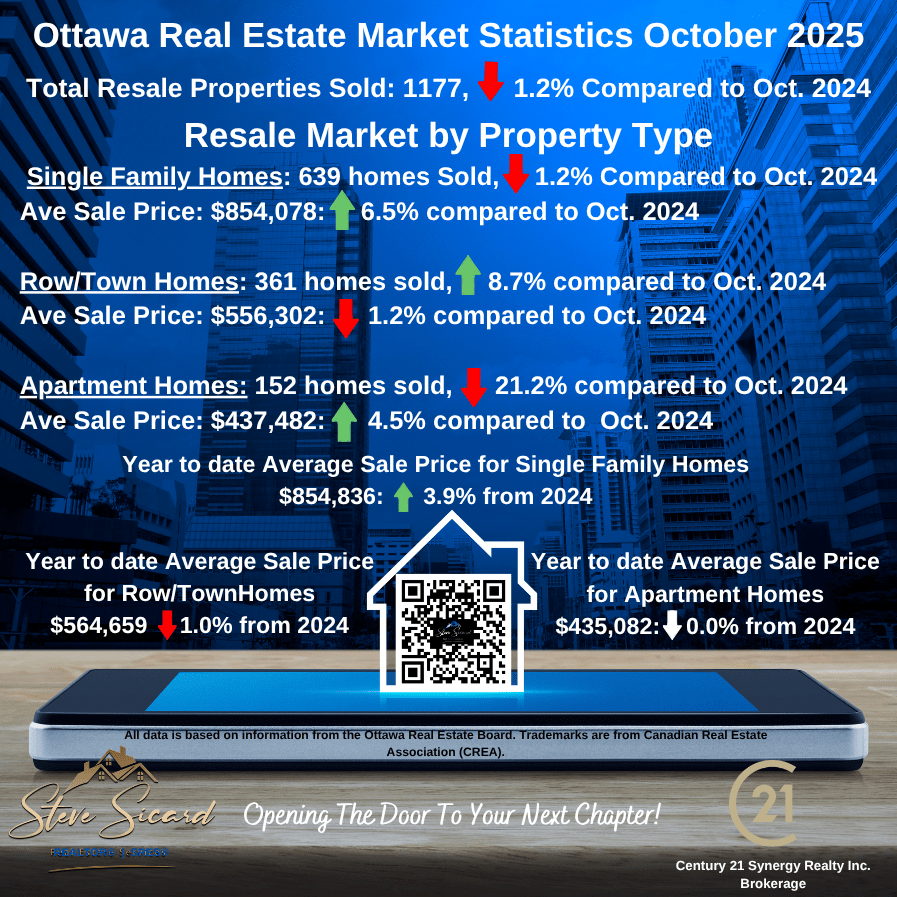
Ottawa Real Estate Market Update: Why the Capital’s Housing Market Remains Steady Amid Economic Uncertainty
Despite ongoing economic uncertainty across the country, Ottawa’s real estate market continues to show remarkable resilience. As we moved through October, the capital experienced a steady, seasonal shift marked by healthier sales activity and stabilizing inventory levels—clear signs that Ottawa remains one of the most balanced and dependable markets in Canada.
Sales Activity: A Seasonal Boost, but Still Measured
In October, 1,177 homes were sold, an increase of 8.1% from September’s 1,089 transactions. Although this represents a slight 1.2% dip year over year, the month-over-month improvement reflects the typical fall momentum the region sees before heading into winter’s slower pace.
Prices Hold Strong as Demand Remains Solid
The average sale price in Ottawa climbed to $709,002, marking a 2.7% increase from September and a 5.7% rise compared to October 2024. This upward movement indicates that underlying demand remains healthy, even as buyers proceed with caution.
Inventory Levels Begin to Ease
Ottawa saw 2,405 new listings in October, a notable 15.1% decline from September 2025, though still 13.4% higher year over year. This seasonal drop is consistent with long-term market patterns.
More importantly, active listings decreased from 4,388 in September to 4,232 in October—a 3.6% reduction. While supply remains higher than in the previous few years, this fall decline suggests that inventory levels may be starting to stabilize within a balanced range.
The months of inventory metric eased from 4.0 to 3.6, indicating a modest tightening between supply and demand as the fall market settled.
Interest Rate Cuts Offer a Glimmer of Optimism
On October 29, 2025, the Bank of Canada issued its second consecutive rate cut, lowering the policy rate by 25 basis points to 2.25%. This move provides welcome relief to borrowers and may help fuel activity heading into the spring market.
However, the Bank signaled that this would likely be the final cut in the current cycle—meaning buyers and sellers are still navigating a cautious financial landscape.
Local Factors to Watch
The Ottawa Real Estate Board (OREB) continues to monitor the federal budget and workforce announcements closely. Given Ottawa’s large federal employment base, shifts in government spending or staffing often influence the local market.
A Balanced, Healthy Market Heading Into Year-End
Overall, Ottawa’s housing market remains stable, balanced, and fundamentally healthy. With steady prices, manageable inventory, and modestly improving demand, the city is entering the winter season on solid footing.
OREB President Paul Czan summarizes it well:
“Ottawa’s market continues to demonstrate balance and resilience. We’re seeing modest growth in sales activity, stable pricing, and a seasonal easing of elevated inventory levels. The recent rate adjustments provide optimism for the coming months, but economic uncertainty looms, and buyers and sellers remain cautious. The current environment points to a steady market rather than a rapid shift in either direction.”
As Ottawa moves toward the end of the year, the market appears poised for continued stability—making it a strong environment for both buyers and sellers who are prepared and informed.
You can get custom market updates based on your neighbourhood and how often you’d like to receive them: ✅ Monthly ✅ Quarterly ✅ Semi-annually ✅ Annually
Just click the button below to submit your request — and I’ll make sure you get clear, easy-to-understand updates that matter to you and your home.
👉 [Request Your Neighbourhood Report]
.png)
📈 What the Bank of Canada’s Rate Cut Means for Ottawa’s Housing Market
On September 17, the Bank of Canada made a move that’s got buyers and sellers paying attention — they cut their key policy interest rate by 0.25%, bringing it down to 2.5%.
The reason? Slowing global growth and easing inflation pressures. In plain English, the Bank wants to help keep the economy steady — and that small rate cut could open new doors for homebuyers who’ve been sitting on the sidelines waiting for a break.
So what does this mean for Ottawa’s real estate market? Let’s take a closer look.
🏡 Ottawa’s Market: Staying Strong Through the Fall Slowdown
September usually brings a bit of a seasonal slowdown — kids are back in school, families are busy, and the market takes a breather. But Ottawa showed its usual resilience this fall.
Here’s what’s standing out:
Sales are still above 2024 levels, even though activity eased slightly.
Prices remain stable despite more homes coming on the market.
The rate cut could boost confidence for first-time buyers and bring a little extra energy to the market in the months ahead.
Paul Czan, President of the Ottawa Real Estate Board (OREB), summed it up perfectly:
“September reinforced Ottawa’s resilience. Sales were nearly 2.4% higher than last year, and prices are holding steady despite more listings coming to market.”
He also noted that while single-family home sales are slowing a bit, townhomes are keeping things balanced. And although Ottawa’s housing mix continues to grow, there’s still a shortage of “missing middle” homes — like townhouses and smaller family-friendly options — that bridge the gap between condos and detached houses.
📊 Ottawa Market Snapshot (September 2025)
Total sales so far this year: 11,025 — up 3.9% from this time in 2024
Average sale price (September): $690,397 — up 0.3% year-over-year
Year-to-date average price: $699,910 — up 2.7% from the first nine months of 2024
Overall, Ottawa’s market remains balanced — steady prices, steady demand, and cautious optimism as rate cuts begin to ripple through the economy.
💬 Want Market Info That’s Specific to Your Neighbourhood?
Curious about how your local market is doing — whether prices are rising, holding steady, or starting to shift?
You can get custom market updates based on your neighbourhood and how often you’d like to receive them: ✅ Monthly ✅ Quarterly ✅ Semi-annually ✅ Annually
Just click the button below to submit your request — and I’ll make sure you get clear, easy-to-understand updates that matter to you and your home.
👉 [Request Your Neighbourhood Report]
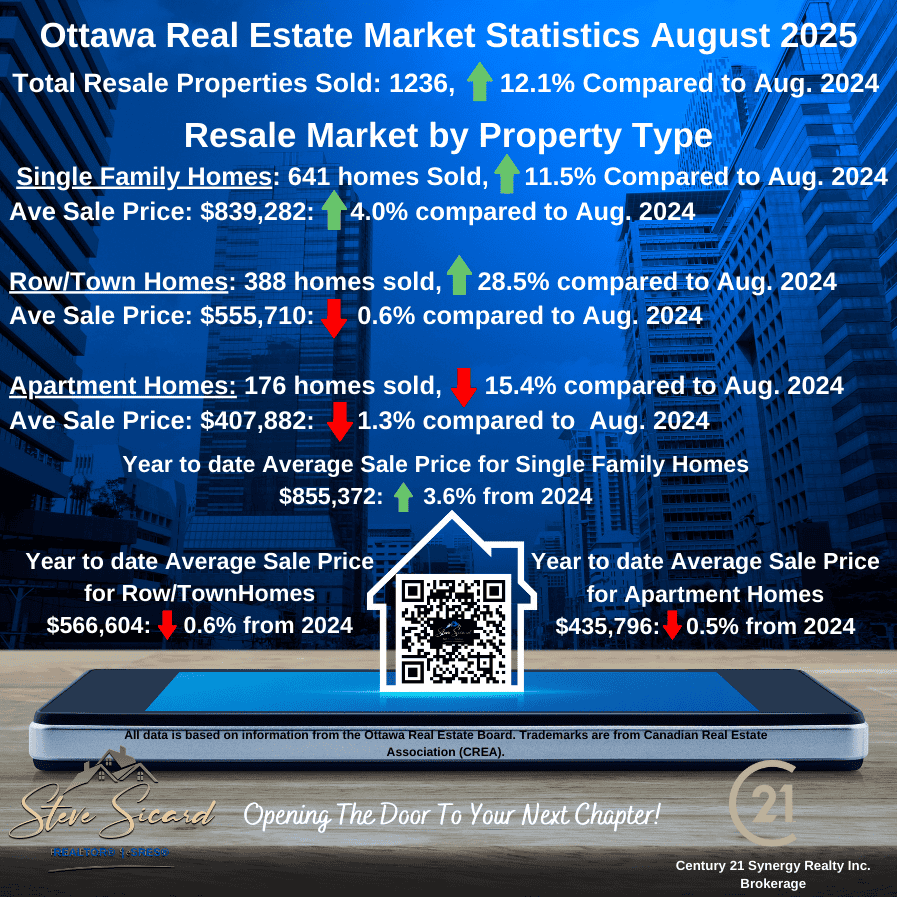
Ottawa Real Estate Market Update – August 2025 🏡✨
As summer winds down, Ottawa’s real estate market is showing plenty of life. Prices are trending upward, sales remain strong compared to recent years, and both buyers and sellers are gearing up for what’s typically one of the busiest times of the year — the fall market.
Home Sales 📊
In August 2025, a total of 1,236 homes were sold across the Ottawa Real Estate Board (OREB) region.
That’s fewer than the 1,318 sales in July and 1,602 in June, but still represents a 12.1% increase compared to last August.
The slowdown from June into August is normal, reflecting the seasonal shift from the busy spring to quieter summer months.
So far this year, Ottawa has seen 9,936 home sales — a 4.1% increase over the same period in 2024.
Prices 💰
The average sale price in August was $686,536, up 3.6% from last year.
The year-to-date average price sits at $700,828, about 3% higher than the first eight months of 2024.
In total, the value of homes sold in August hit $850 million, which is a 16% jump from last year.
These numbers show that Ottawa’s housing sector continues to play a big role in fueling the local economy.
Listings & Inventory 🏠
2,121 new listings were added in August, an 8.6% increase compared to last year.
There were 3,971 active listings at month’s end, up 13.3% from last year and a notable 37.1% higher than the five-year average for this time of year.
When we look at months of inventory (how long it would take to sell all current listings at today’s sales pace), Ottawa sat at 3.2 months. That’s unchanged from July and identical to last August.
👉 A 3.2-month supply is generally considered a balanced market, meaning demand and supply are keeping pace with each other.
The Big Picture 🌎
Ottawa is seeing renewed momentum, with buyers and sellers re-engaging after the slower summer pace. Prices are holding strong, sales are up compared to last year, and inventory has grown — giving buyers more choice.
At the same time, market watchers are mindful of outside factors like federal employment trends and U.S. trade policies, which could influence Ottawa’s economy in the months ahead.
✅ Takeaway for Buyers & Sellers
Buyers: You’ll find more inventory than last year, but competition is still healthy. Be prepared to act quickly on the right home.
Sellers: Strong prices and steady demand mean it’s still a great time to list, especially as the fall market ramps up.
Ottawa’s real estate market continues to reflect balance, stability, and opportunities for both sides of the transaction.

Ottawa’s July Housing Market: Still Steady & Strong!
Ottawa’s housing market is holding its ground—steady demand, moderate price growth, and plenty of homes to choose from—while other markets are seeing way more ups and downs.
That said, it’s smart to keep an eye on what’s happening across Ontario. In some places, sales are slowing, prices are dipping, and homes are sitting on the market longer.
Ottawa’s known for being a bit more stable—thanks to steady jobs and a growing population—but we’re not completely immune. Big changes in other parts of the province or country can ripple our way.
Right now, there are more homes for sale than this time last year (and compared to the 5-year average). That might be an early sign of more supply coming on the market. But here’s the flip side—the sales-to-new-listings ratio went up from 51.7% to 55.1% over the past year, showing demand is still keeping up. For buyers, this means more choice!
In the condo market—especially downtown—demand seems to be softening. But overall, Ottawa is still standing out for its resilience.
As Paul Czan, President of the Ottawa Real Estate Board, says: 💬 “Our fundamentals remain strong—steady demand, balanced inventory, and moderate price growth.”
Want more information or have any other questions, I am very happy to help. Click HERE to request more information or to ask your question(s).

Ottawa Real Estate Market Update - June Snapshot
Something to take into account: when you see headlines about “The Canadian Real Estate Market”—even from reputable sources—take a closer look. The data may not reflect what’s happening in your specific market or home type.
I recently came across an article with the headline: “Home Sales at Crisis Levels in Sagging Market!” While that may be true for certain cities or property segments, it doesn’t tell the full story. In fact, the Ottawa market tells a different tale. June home sales—excluding condo apartments—were up compared to June 2024, and new listings were also on the rise.
It looks like June 2025 was busier than June 2024. Home sales were 10.6% higher compared to June 2024, and new listings increased by nearly 14% compared to June 2024. According to OREB President Paul Czan, this confirms that our spring market may have arrived a little late—but it certainly showed up strong.
More homes hitting the market means more choice for buyers, which is great news. Sellers, however, will need to be strategic: price thoughtfully and prepare your home to shine if you want to stand out.
One segment that’s still feeling the pressure is apartments. Condo sales were down about 20% compared to June 2024.
Still, Ottawa remains a stable, resilient market. We’re seeing a return to more traditional seasonal activity. With families aiming to move before the school year and students coming back to the city, a stronger fall.
Have you got any questions? Reach out HERE, for a casual, no-obligation chat—I'm happy to help you make sense of it all!

Ottawa Real Estate Market Update: Why Buyers Are Coming Back Strong in 2025"
"Spring Market Surge: What Ottawa Buyers and Sellers Need to Know Now"
So far this year, home sales have been tracking pretty closely to 2024—but here’s the twist: sales in April 2025 jumped over 33% compared to last April. That’s a major spike, and it suggests our spring market just arrived a little later than usual.
It is also worth noting that the median time to sell a home was 17 days, that is from day listed to day sold firm, and that homes sold for an average of 98.8% of the asking price.
Why the delay? It has to do with April’s federal election and the uncertainty around U.S. tariffs — both had a lot of people hitting the pause button on real estate decisions.
Now that things are settling down, we’re seeing more listings hit the market, and buyers are starting to re-engage. If you’re thinking of selling, just remember—rising inventory means smart pricing and great presentation are more important than ever.
Unlike markets like Toronto or Vancouver that are showing signs of slowing, Ottawa is holding steady. Most homes are still selling close to the asking price, and the atmosphere feels a lot less frantic than in other cities.
And with the Bank of Canada holding interest rates steady, buyers are feeling more confident that now could be the right time to make a move—without worrying about missing out on a better rate down the road.
Thinking of jumping in? Let’s talk about how this market shift could work in your favour.

🏡 Ottawa Real Estate Update – April 2025 Recap
Hey neighbor! 👋 If you’ve been wondering what’s going on in Ottawa’s housing market lately, here’s a quick and friendly breakdown.
April home sales were a bit quieter than usual—about 17% below the 5-year average and 16% under the 10-year average. But here’s the good news: sales are picking up month-to-month, and that’s a great sign as we move deeper into spring. 🌸
There are more homes on the market right now than we’ve seen in the past few years, which is helping shift things toward a more balanced market—not too hot, not too cold.
Since the federal election, buyers seem to be coming back with more confidence. They're still cautious though—taking their time and being more selective than we’ve seen in past years.
Sellers are adjusting too. Homes are sitting a little longer, so strategic pricing and solid presentation really matter. If a home is priced right and looks great, it’s still selling—and yes, sometimes even in multiple offers.
We’re also keeping an eye on how the federal government’s housing promises will actually roll out. More supply, better affordability, and help for first-time buyers would be a big win here in Ottawa.
Have questions or thinking about buying or selling? Let’s talk—no pressure, just info.
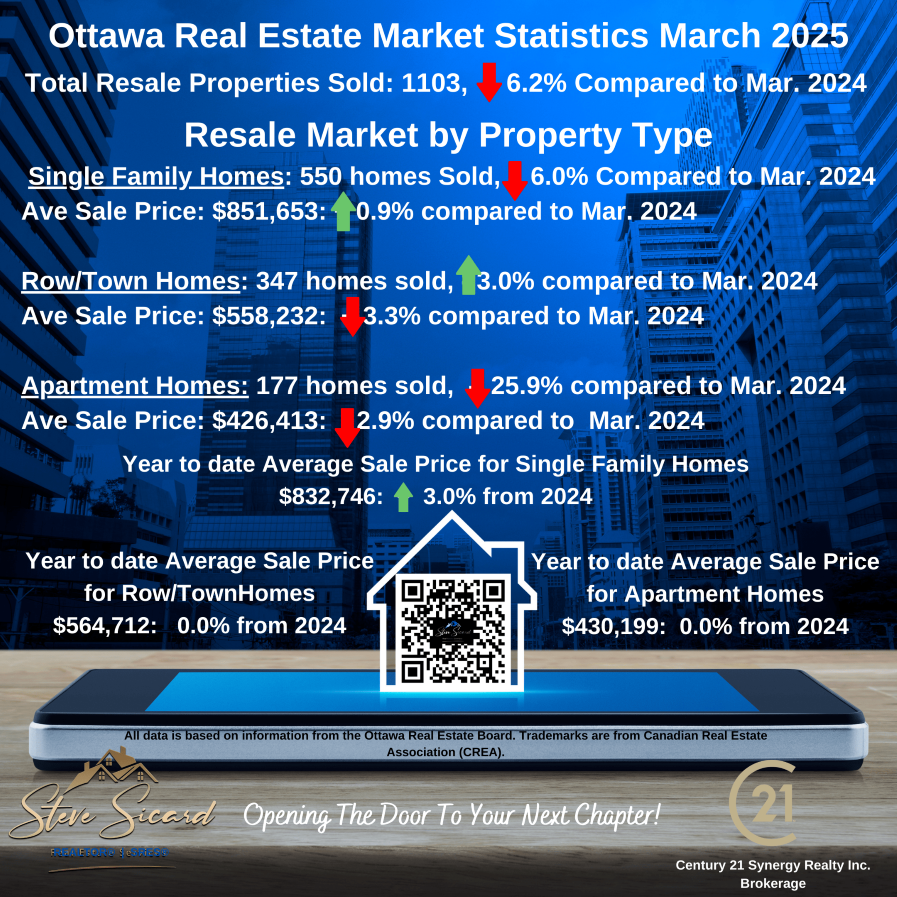
So, the Ottawa housing market in March 2025?
Pretty steady overall. Sales were a bit lower compared to last year, but things are picking up month by month now that spring’s rolling in.
Both buyers and sellers are still a little cautious—which makes sense with the economy being a bit unpredictable and an election on the horizon. But the good news? Lower interest rates are pulling more people back into the market. People are starting to make moves again.
Looking ahead though, there are still some concerns around trade and tariffs, especially when it comes to new construction. That could make the housing supply issue even trickier.
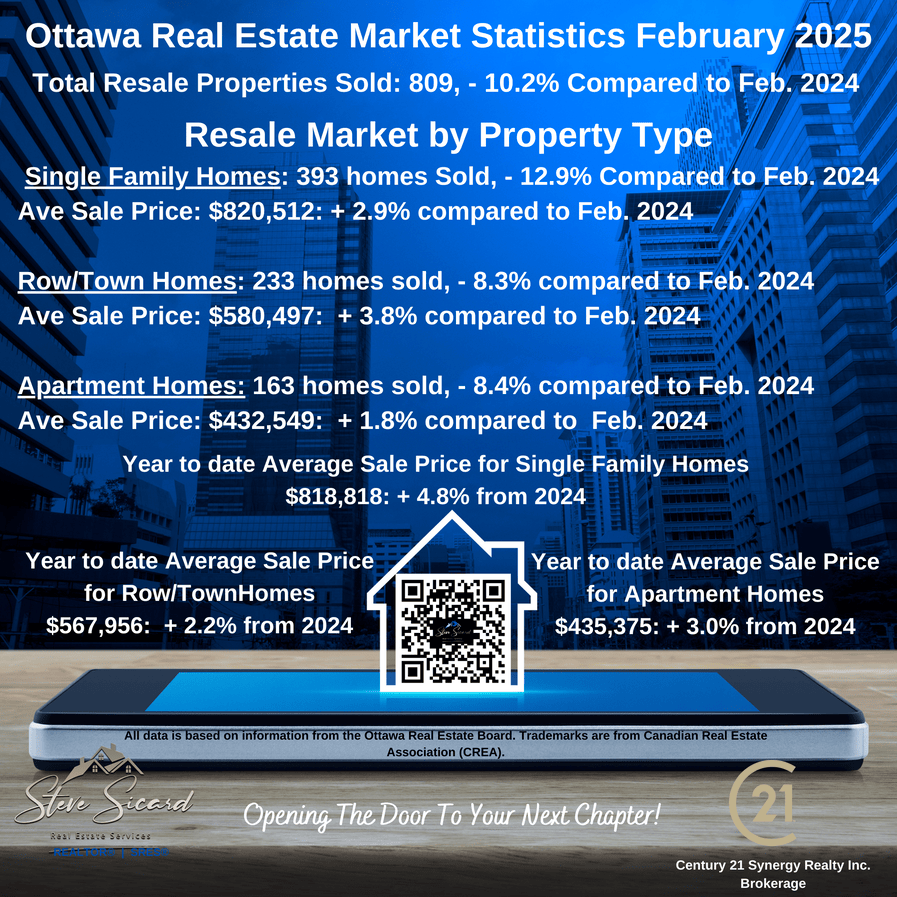
February Real Estate Market Update – Big News for Buyers & Sellers!
More homes sold in February than in January! 809 homes sold last month compared to 617 in January—momentum is building as we head into spring!
Major news! The Bank of Canada just cut the key lending rate by 0.25% to 2.75%! This is great news for buyers and sellers, as lower rates mean more affordability and stronger market activity.
More inventory, more options! With 1,668 new listings in February, buyers have more choices without an oversupply, keeping demand high for sellers. Some neighborhoods still have limited availability, making well-priced homes sell quickly!
Market Stats You Should Know:
- 98.6% list-to-sale ratio (homes selling very close to asking price)
- Median days on market: 19 days (still moving fast!)
- More balanced market (60 days is considered fully balanced)
Spring Market Outlook: Expect an active market ahead, though some buyers and sellers may move cautiously due to the upcoming federal election and ongoing tariff uncertainties.
Thinking about buying or selling? Now is the time to take advantage of lower interest rates! Drop your questions below or DM me anytime!
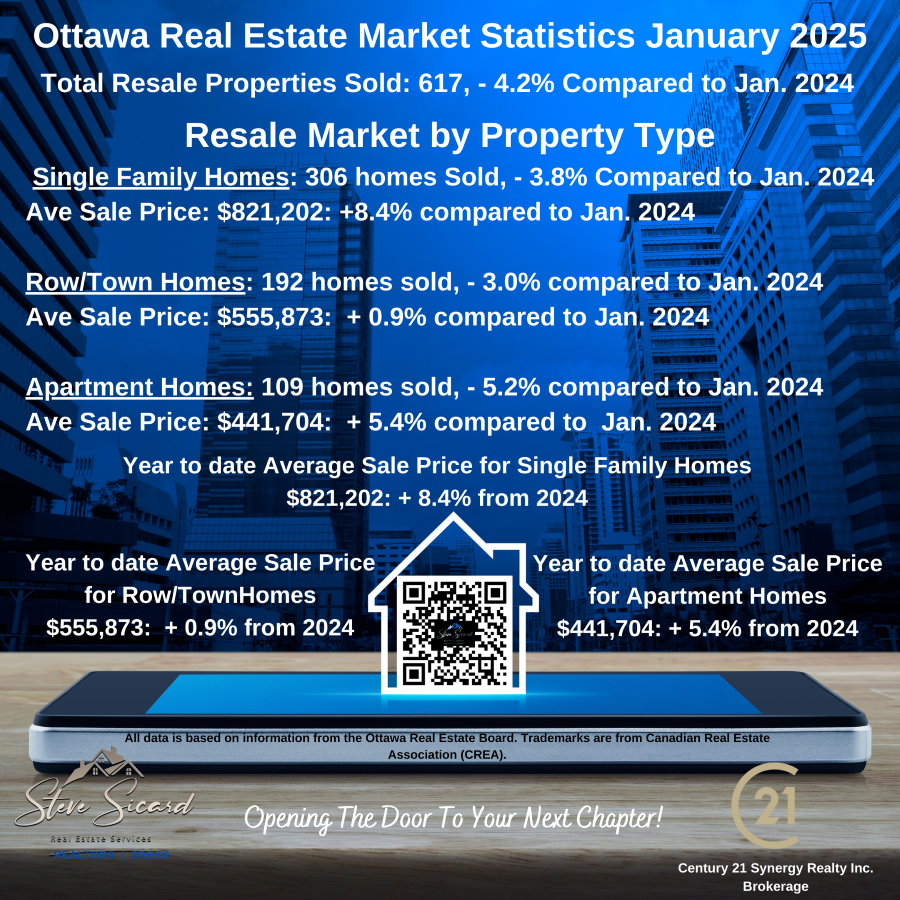
The January home resale numbers, although lower than they were for January 2024, are still very good.
What matters most is that the market is good for home buyers and for home sellers.
For buyers, there were 1359 new home listings in January, which is a 3% increase compared to January 2024.
Overall, at the end of January, there were 3312 homes available on MLS, a 57.3% increase compared to the end of January 2024.
Based on the number of homes sold in January, if no more homes come on the market, there is 5.37 months of inventory, which means it would take that much time to sell all the currently available listings. Which is much better than the 2 to 3 months we saw during Covid
For sellers, the good news is that the median days on market (DOM) is 43, which means that midpoint for the time a home is listed, to the time that it is sold, is 43 days. A balanced market would have an average of 60 DOM's.
This shows that with a median of 43 days, some homes were up around 86 days, but many were less than the 43 days.
The list to selling price ratio was an average of 98%. This is good for home sellers who price their home to the market. All said, with around 43 days to sell your home once it is listed and a selling price around 98% of the asking price, you are in a very good market.
If you are looking to sell and buy, you also have more choice.
🚨 The market is shifting! 🚨 Whether you're a buyer or seller, now might be the perfect time to make your move. 🏡📈
💬 What do you think about the current market? Are you planning to buy or sell this year? Let’s chat!
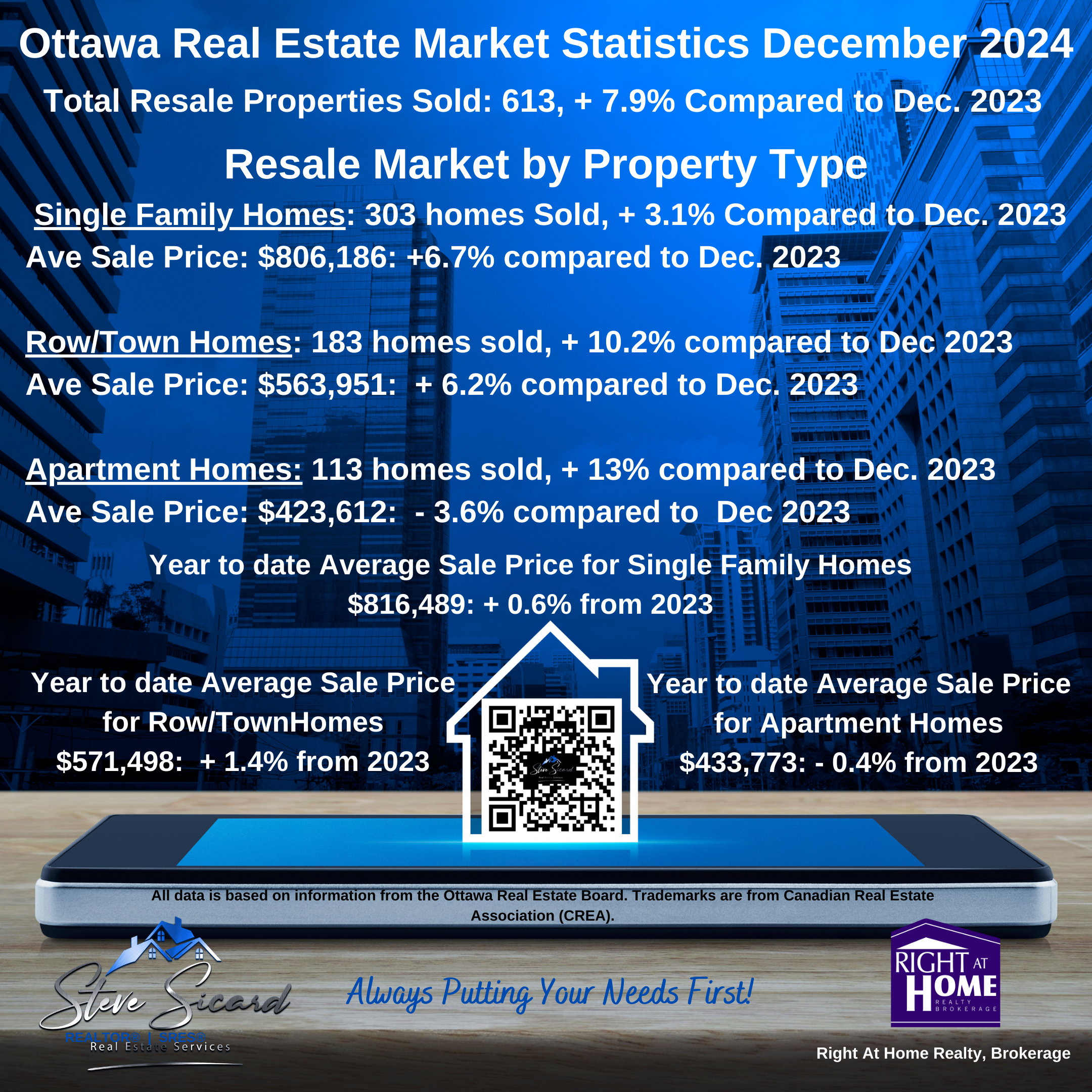
The final numbers for 2024 are now in!
The number of homes sold in December 2024 was 7.9% higher than the number sold in December 2023.
For the 2024 year, the total number of homes sold was 11.8% higher than for the 2023 year.
There was also a 13.6% increase of homes listed in December 2024 compared to December 2023,
This is a good sign for the market and for buyers, although, there is still a lack of inventory in some areas and price ranges.
The consecutive interest rate reduction by the Bank of Canada, as well as the longer amortization periods and increase to the amounts of insured mortgages have helped buyers.
Here is a recap of Regulatory changes and updates:
1) Effective Dec 15 - the limit on insured mortgages increases to 1.5 million from 1M.
2) Amortization Period for all first-time homebuyers and buyers of new-build properties is extended to 30 years from 25.
3) Removal of Stress Test for Straight, Stand-Along Uninsured Renewal Switches. Insured and uninsured mortgages no longer need to be stress-tested for qualification purposes.
4) Insured Refinances Eligible homeowners can access an insured refinance of up to 90% of their improved property value for construction funds. This change encourages homeowners to add a secondary suite to their property. This can help accommodate families or generate rental income.
Want more information, or have a question, please let me know. I am happy to help!
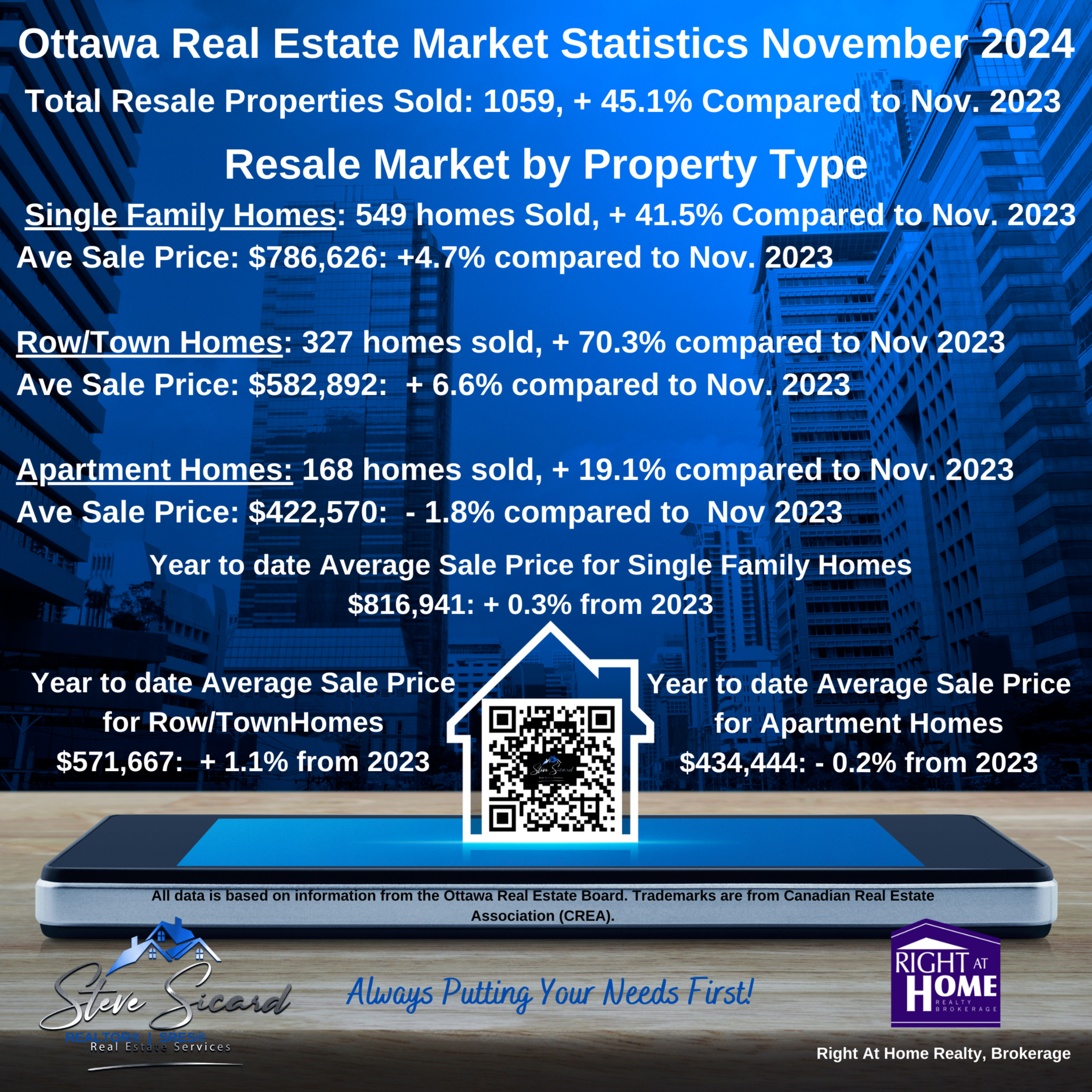
The home sales in November were stronger than they were for November 2023. In fact they were 45.1% higher. The average price of a home was up 4.6%. Please note that these numbers include all property types.
The Bank of Canada lowered the key interest rate by.50% to 3.25% this morning, For people with variable rate mortgages, rate cuts can mean more of their money goes toward the principal on their mortgage, and less towards interest. It can also help home buyers who opt for a variable rate mortgage and folks looking to refinance their mortgage. The impact on fixed rate mortgages won't be know for a while.
Adding in the following Regulatory Changes and Updates, should bode well for home buyers and sellers.
1) Effective Dec 15 - the limit on insured mortgages increases to 1.5 million from 1M.
2) Amortization Period for all first-time homebuyers and buyers of new-build properties is extended to 30 years from 25.
3) Removal of Stress Test for Straight, Stand-Along Uninsured Renewal Switches. Insured and uninsured mortgages no longer need to be stress-tested for qualification purposes.
4) Insured Refinances Eligible homeowners can access an insured refinance of up to 90% of their improved property value for construction funds. This change encourages homeowners to add a secondary suite to their property. This can help accommodate families or generate rental income.
Want more information, or have a question, please let me know. I am happy to help!
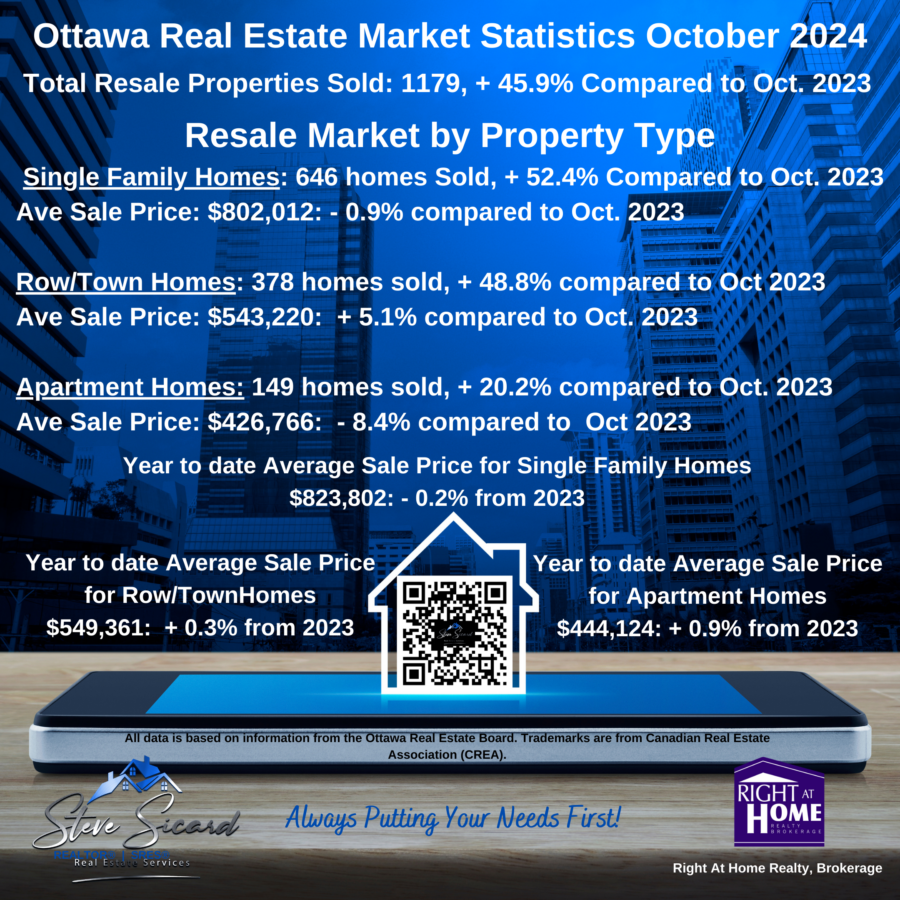
2024 home sales have continued to outperform the number of sales by month in 2023.
The latest interest rate reduction of .50% has helped to generate more optimism, although in speaking with home buyers, they are waiting for further drops in the rates.
This can be an issue. The number of homes available is up over last year, but housing starts are still very low.
The current market is balanced and homes are selling on average around 98% of the list price.
If you are buying, get pre-approved now, find your home, and take a longer closing if possible, so if rates go down, you will get the lower rate. This way you avoid the possible issue of competing with more buyers if the rates go down again, and the number of available homes remain at today’s levels, or less. This would create competition and drive home prices higher, negating any gain made by a lower interest rate.
Want more information, do not hesitate to ask! I am happy to help.
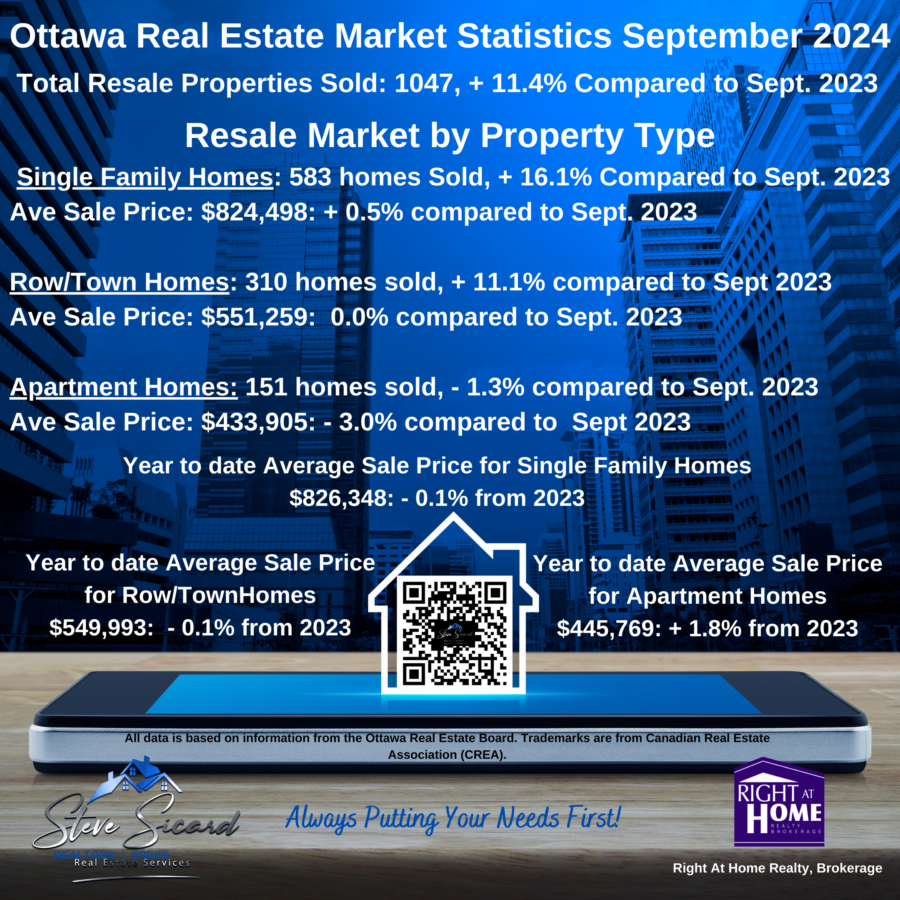
The strong August market carried over into September. Home sales this September were 11.4% higher than they were in September 2023.
There is some speculation that the Bank of Canada, with their October 23rd policy decision, could lower the key lending rate a further .5%, with some economists saying that even if they do not go to that level, they believe that they will lower the rate by .25%.
If you are buying and aren’t pre-approved, get out now, get pre-approved, and find your house. You could face more competition for your dream home after the announcement, and then you may have to pay more than you would if you get out now!
Heading into October, the market was balanced, so no advantage to either buyers, or sellers. Homes sold for around 98% of the asking price in September. This could change, depending on what the Bank of Canada announces later this month.
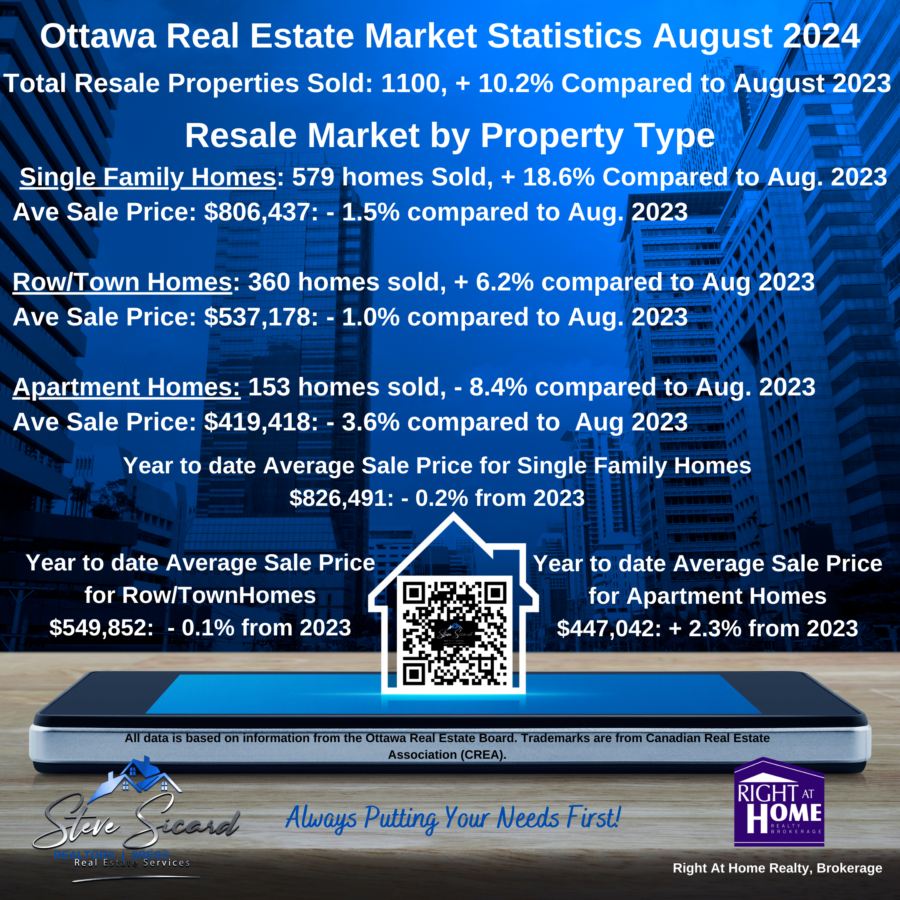
Based on the summer market, the outlook for the fall market is encouraging and it looks like we will be looking at a pretty active fall market!
The third consecutive interest rate drop is welcome news and it should help both buyers and sellers.
More homes are coming on the market compared to the same time last year.
Based on the number of days I have seen that it is taking for homes to sell, the increased selection has buyers taking more time to look and decide.
Want more information, do not hesitate to ask! I am happy to help.
REALTOR® | SRES®Seniors Real Estate Specialist®
Location

200-4366 Innes Road
Orleans, ON, K4A 3W3